Contact Kelly McNamara for information on products, services or locations.
Choosing a reliable ODM O Rubber Ring Manufacturer begins with more than comparing prices or browsing polished product catalogs. A dependable partner must understand compound selection, mold design, dimensional control, and the real conditions surrounding your application. An O ring may look simple, yet a small tolerance error can cause leakage, downtime, or repeated replacement.
Quality expert W. Edwards Deming stated, “Quality comes not from inspection, but from the improvement of the production process.” This principle remains highly relevant when evaluating an ODM supplier. Look for evidence of controlled mixing, documented curing conditions, in-process testing, and traceable batch records. Ask how the manufacturer manages drawings, prototypes, tooling changes, and production feedback. Clear answers matter.
Details reveal capability.
A serious ODM O Rubber Ring Manufacturer should explain material behavior under heat, pressure, chemicals, and compression. It should recommend suitable elastomers instead of accepting every specification without questions. Request samples, inspection reports, test methods, and realistic production timelines. Factory photographs help, but direct technical communication is stronger evidence.
Still, no supplier is perfect. A certificate does not guarantee consistent performance, and an impressive sample may not represent mass production. This guide will examine those uncomfortable gaps, including unclear tolerances, weak communication, limited testing, and hidden tooling risks. Readers will gain a practical framework for comparing manufacturers through experience, technical evidence, and accountable service—not attractive promises alone. Reliability is built in the details.
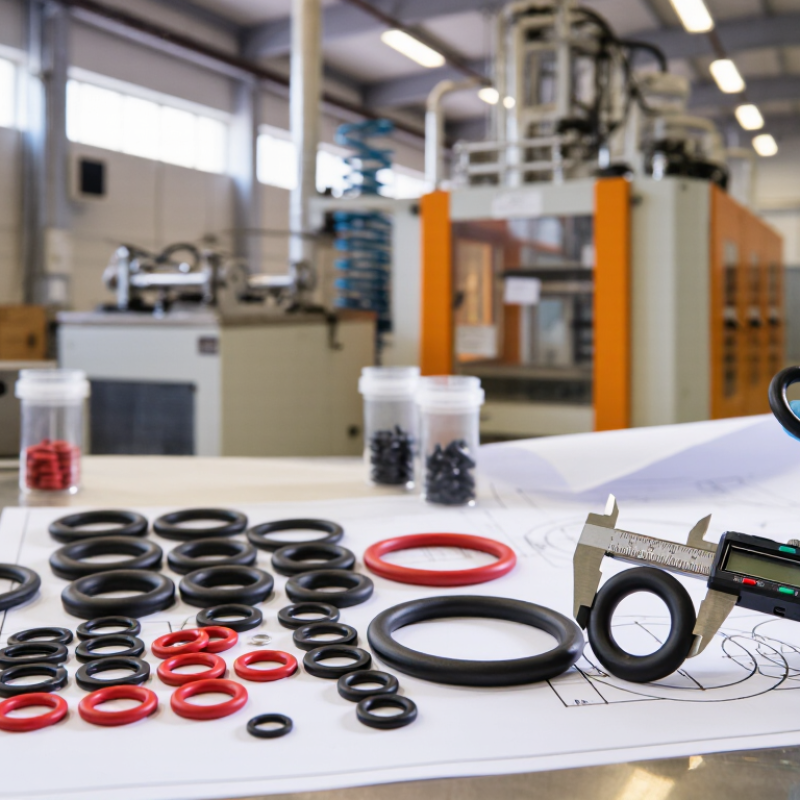
Before selecting an ODM O-ring manufacturer, define the sealing job precisely. Record the groove dimensions, shaft movement, pressure, temperature, media, and installation method. A static flange seal differs greatly from a dynamic hydraulic seal. Small differences matter.
Use recognized standards when possible. ISO 3601 supports O-ring dimensions, tolerances, and quality classification. SAE AS568 can define common inch-series sizes. For pneumatic equipment, the U.S. Department of Energy reports that compressed-air leaks can waste 20–30% of compressor output. Poor sealing is costly. Your specification should therefore include allowable leakage, friction limits, service life, and inspection methods.
Material selection needs practical testing. EPDM may suit hot water and steam, while FKM often handles oils and elevated temperatures. However, chemical compatibility depends on concentration, pressure, and exposure time. Request compound data, hardness tolerance, compression-set results, and batch traceability. For sour-gas or high-pressure applications, reference NACE MR0175/ISO 15156 requirements where applicable.
Do not specify only “a standard rubber ring.” That is incomplete. Include operating peaks, not just normal conditions. I have seen designs fail because cleaning chemicals were ignored. Test samples under real temperature cycles and media exposure. According to ASTM D395, compression-set testing helps evaluate deformation after heat and compression, but it cannot replace application testing. A reliable ODM partner should challenge unclear requirements, document assumptions, and provide measurable validation records.

How to Choose a Reliable ODM O Ring Manufacturer?
A reliable ODM O ring manufacturer should prove material expertise with more than a product catalogue. Ask how engineers select compounds for heat, pressure, chemicals, and repeated movement. Request material certificates, batch traceability, and test data for hardness, tensile strength, elongation, and compression set. A small sample can reveal swelling, surface cracks, or poor recovery after compression.
Customization should begin with your actual working conditions, not a copied drawing. Share the groove dimensions, sealing pressure, operating temperature, media exposure, and installation method. Experienced engineers can recommend the right cross-section and tolerance range. They should also explain whether a proposed material needs a coating, special finish, or revised geometry. Short answers are a warning sign.
Engineering capability becomes visible during development. Look for mold-flow reviews, prototype testing, dimensional inspection, and documented design changes. Ask whether the manufacturer can investigate leakage through root-cause analysis. In one project, a seal failed because the groove corner was too sharp, not because the rubber was defective. That detail mattered. No supplier is perfect. I would question any team promising zero risk without test evidence. Good manufacturers admit uncertainty, record assumptions, and improve the design after failed samples. Their technical communication should remain clear when specifications become difficult.
Verify material expertise, customization, and engineering capabilities by checking whether the manufacturer can recommend compounds for the required temperature range and application conditions.
Typical continuous service-temperature references: NBR up to approximately 100°C, EPDM up to 150°C, FKM up to 200°C, and VMQ silicone up to 200°C. Actual performance depends on compound formulation, pressure, media compatibility, and design. A reliable ODM partner should support material selection, custom tooling, dimensional validation, and application-specific engineering.
How to Choose a Reliable ODM O Ring Manufacturer?
Evaluate Manufacturing Quality Systems and Product Testing Standards
A reliable ODM O ring manufacturer should show how quality is controlled, not merely display certificates. Ask for documented procedures covering material receiving, mold setup, vulcanization, trimming, inspection, and packaging. An ISO 9001-based system can provide structure, but daily discipline matters more than a framed certificate. During a factory visit, inspect batch labels, inspection records, and storage conditions. Rubber compounds should be protected from heat, light, moisture, and contamination.
Product testing must match the sealing application. Request material certificates and batch-specific test reports, not generic laboratory sheets. Useful tests include hardness, tensile strength, elongation, compression set, dimensional accuracy, and leakage performance. For demanding applications, review resistance to temperature, pressure, chemicals, and aging. Standards such as ISO 3601 or ASTM D2000 may support consistent specifications, but the correct standard depends on the design and operating environment.
Traceability is essential. Each package should connect to a compound batch, production date, mold number, and inspection result. I have found that small record gaps can create serious uncertainty later. A supplier should also explain nonconforming product handling and corrective actions. No system is perfect. Honest manufacturers can identify past defects, explain their causes, and show measurable improvements. Before approving production, test samples under realistic conditions, including temperature cycling and extended compression. A polished report is useful. Physical evidence is stronger.
| Evaluation Dimension | Relevant Standard or Requirement | What a Reliable ODM Manufacturer Should Demonstrate | Recommended Verification Evidence | Why It Matters |
|---|---|---|---|---|
| Quality management system | ISO 9001:2015; ISO 13485:2016 for medical-device applications; IATF 16949 for automotive supply chains where applicable | Documented procedures for design control, purchasing, production, inspection, nonconformity handling, corrective action, and continual improvement | Current certificate, certification scope, issuing certification body, audit status, quality manual summary, and corrective-action records with confidential information removed | A structured quality system reduces process variation and makes problems traceable and correctable. |
| Rubber compound control | ASTM D2000 or ISO 3601 material and classification requirements, depending on the application | Controlled compound recipes, approved raw-material suppliers, lot identification, mixing records, and change-control procedures | Compound specification, batch records, incoming inspection results, material certificates, and retained samples | Compound consistency directly affects sealing performance, chemical resistance, compression set, and service life. |
| Dimensional inspection | ISO 3601 for O-ring dimensions and tolerances; AS568 may be used for inch-size identification | Inspection of inside diameter, cross-section, flash, parting line, surface defects, and visual appearance using calibrated equipment | First-article inspection report, sampling plan, calibrated measuring equipment list, and measurement-system records | Correct dimensions help prevent leakage, extrusion, excessive friction, and installation damage. |
| Tensile strength and elongation | ISO 37 or ASTM D412 | Routine or qualification testing using standardized dumbbell specimens, controlled conditioning, and documented test settings | Test reports showing tensile strength, elongation at break, specimen type, conditioning, test speed, and test date | These properties indicate whether the elastomer can withstand installation, deformation, and operating loads. |
| Hardness verification | ISO 48-4 or ASTM D2240, using the applicable Shore hardness method | Hardness measured on representative samples with controlled temperature, suitable specimen thickness, and calibrated durometers | Hardness results, measurement location, instrument calibration status, and permitted tolerance defined in the product specification | Hardness influences sealing force, extrusion resistance, friction, and compatibility with the gland design. |
| Compression set | ISO 815-1 or ASTM D395 | Testing at a specified temperature, time, deformation, and material condition that reflects the intended service environment | Compression-set report identifying the method, test temperature, duration, specimen dimensions, and recovery measurement | Lower permanent deformation generally supports longer-lasting sealing force, although acceptance limits depend on the application. |
| Fluid and chemical resistance | ISO 1817 or ASTM D471 | Testing in the actual or representative media, including temperature and exposure time relevant to the application | Pre- and post-immersion measurements for mass, volume, hardness, tensile properties, and visual condition | Swelling, shrinkage, softening, or embrittlement can cause leakage and premature failure. |
| Heat aging and low-temperature performance | ISO 188 or ASTM D573 for heat aging; ISO 812 or ASTM D1329 for low-temperature behavior where applicable | Qualification testing that reflects the specified operating temperature range and exposure duration | Aged-property comparison, temperature profile, exposure duration, acceptance criteria, and test-equipment calibration records | Temperature changes can alter elasticity, hardness, compression set, and sealing reliability. |
| Process capability and consistency | Statistical process control and risk-based quality planning; customer-specific requirements may define capability targets | Monitoring of critical dimensions and process parameters, with documented reaction plans for out-of-control conditions | Control charts, capability studies, process flow diagrams, PFMEA, control plans, and records of corrective actions | Stable processes are more reliable than end-of-line sorting alone and support repeatable production at scale. |
| Traceability and batch release | Document-control and product-identification practices required by the applicable quality-management system | Ability to link finished O-rings to compound batch, molding lot, inspection results, packaging, and shipment records | Lot labels, certificates of conformity, batch-release checklists, retention policy, and recall or containment procedure | Traceability enables targeted containment, root-cause analysis, and efficient handling of field issues. |
| ODM design and change management | Design-validation principles, customer-specific specifications, and formal engineering-change control | Review of gland design, material selection, tolerance stack-up, tooling, sampling, validation, and approval before production changes | Design review records, validation plan, approved drawings, change-notification procedure, and sample-approval documentation | Controlled design changes prevent unapproved differences in material, geometry, tooling, or performance. |
Note: Acceptance limits should be defined by the application, material, operating conditions, drawing, and applicable customer or industry requirements rather than by a universal O-ring specification.
How to Choose a Reliable ODM O Ring Manufacturer?
A reliable ODM partner should prove performance before discussing price. Request prototype samples using your actual rubber compound, hardness, and cross-section. Check sealing under pressure, temperature, compression set, and repeated movement. ISO 3601-1 provides dimensional requirements for many industrial O rings, but design validation remains your responsibility. Do not accept a polished sample without test records. That mistake is expensive.
Review production capacity with evidence. Ask about molding machines, cavity numbers, monthly output, inspection equipment, and backup production plans. A 2024 Supply Chain Resilience Report found that 74% of organizations experienced supply-chain disruptions during the previous year. Capacity claims need verification. Ask for recent batch records, rejection rates, and traceability documents. Lead times should show each stage, including tooling, sampling, approval, molding, inspection, and shipment. In practice, prototypes may take one to three weeks, while stable production can require four to eight weeks. These ranges vary. Confirm them in writing.
Tips: Compare total cost, not unit price. Include tooling, testing, packaging, freight, scrap, and inventory. Request a quotation with separate prototype and production charges. Clarify tooling ownership and revision costs. A lower quote may hide weaker inspection or inconsistent compounds. I would also place a small pilot order before committing to annual volume. It slows the launch slightly, but it exposes problems while they remain manageable. A 2023 industrial procurement survey reported that cost reduction remained a major priority, yet many buyers still valued delivery reliability more highly. That trade-off deserves careful review.
A reliable ODM O ring manufacturer should communicate clearly from the first technical discussion. Ask how engineers confirm dimensions, material hardness, temperature range, and sealing conditions. Experienced suppliers usually request drawings, pressure data, and installation details before quoting. That matters. A low price means little if the seal fails after repeated compression. Request sample rings and inspect their surface, flash, elasticity, and fit. Keep test records. Small details reveal process discipline.
Tips:
Test communication before placing an order. Send one technical question and observe the response time, accuracy, and willingness to clarify uncertain points. Ask for a production timeline, inspection plan, and corrective-action process. Honest suppliers admit limitations. Perfect promises can be a warning sign.
Compliance should include material documentation, batch traceability, inspection reports, and manufacturing controls suitable for your application. Confirm that records match the actual material used, not only a standard template. During production, ask whether samples are retained and how nonconforming rings are isolated. After-sales support also deserves careful review. A dependable supplier should investigate leakage, dimensional variation, or early wear with evidence. Photos help, but failed parts may require laboratory testing. My experience is that unclear responsibility causes longer delays than the defect itself. No supplier gets everything right. What matters is whether they respond openly, document the cause, and improve the process.