How to Choose an Industrial Chain Conveyor in 2026?
Choosing an Industrial Chain Conveyor in 2026 requires more than comparing prices and catalogue images. The right system must match the product, route, working environment, and maintenance capability. A heavy pallet needs different chain strength than a small carton. Wet rooms, dusty plants, and high-temperature areas also demand different materials and guarding.
Todd Swinderman, a recognized conveyor engineering authority, offers a useful principle: “Safety is not a feature added to a conveyor; it is designed into the system.” That principle should guide every decision. Buyers should examine load weight, chain pitch, conveyor width, speed, incline, transfer points, and drive capacity. They should also check lubrication access, wear-strip replacement, noise, emergency stops, and spare-part availability. Small details matter. A poorly positioned inspection door can turn a ten-minute task into an hour of downtime.
This guide explains how to evaluate an Industrial Chain Conveyor for modern production demands. It considers automation, energy use, modular construction, data monitoring, and cleaner maintenance practices. It also compares carbon steel, stainless steel, and engineered polymer components. The cheapest option may not remain economical after repeated chain failures. That is uncomfortable, but important.
No spreadsheet captures everything. Operators notice vibration before sensors do. Maintenance teams understand access problems better than designers. Their experience deserves attention. By combining technical specifications with real workplace observations, companies can select equipment that performs reliably in 2026. The final choice should support safe movement, predictable throughput, and practical long-term ownership.
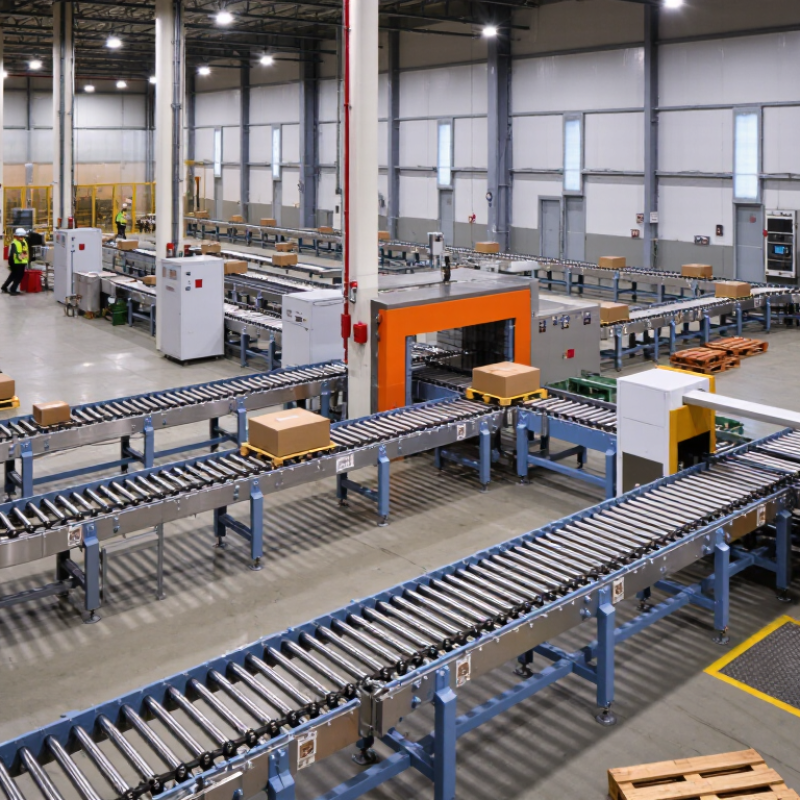
What Is an Industrial Chain Conveyor and How Does It Work?
An industrial chain conveyor is a powered material-handling system for moving heavy, irregular, or palletized loads. It uses one or more endless chains, sprockets, shafts, and a drive motor. The chains carry the product while the sprockets pull them along a fixed route.
Its operation is straightforward. The motor turns the drive shaft, and the shaft rotates the sprockets. Chain links engage with the sprocket teeth, creating continuous movement. Guide rails support the chain and help maintain alignment. In a factory, this system may move steel parts through washing stations, pallets between work areas, or containers into storage.
It sounds simple. The selection is not.
Start with the load’s weight, dimensions, base condition, and required speed. A rough calculation should include acceleration, friction, incline, and peak loading. A first estimate is rarely perfect. Engineers should verify chain tension, shaft torque, frame strength, and emergency stopping performance before installation. Stainless or corrosion-resistant components suit wet environments, while sealed bearings can reduce contamination risks. Dry, dusty areas may require guarded drives and a carefully planned lubrication schedule.
Observe the conveyor’s transfer points. Poor alignment can create noise, vibration, and uneven chain wear. Regular inspections should check elongation, sprocket teeth, fasteners, and lubricant condition. Operators also need clear access for cleaning and maintenance. A conveyor that looks oversized may still fail when loads arrive unevenly or start and stop frequently. That detail is easy to miss during an office-based design review.
How to Choose an Industrial Chain Conveyor in 2026? - What Is an Industrial Chain Conveyor and How Does It Work?
An industrial chain conveyor uses one or more continuous chains driven by sprockets to move unit loads, pallets, bulk materials, or suspended products along a defined path. Use the comparison below as an initial selection guide before final engineering validation.
| Conveyor Type | Typical Load or Material | Typical Speed Range | Typical Load Capacity | Operating Direction and Incline | How It Works | Best Selection Criteria |
|---|---|---|---|---|---|---|
| Roller Chain Conveyor | Pallets, crates, drums, bins, and rigid-bottom containers | 3–30 m/min | 50–2,000 kg per load | Horizontal; generally up to about 5° with suitable load control | Powered chains engage the underside of the load or chain-compatible rollers and transfer it along the conveyor frame. | Choose when the load has a rigid, flat base and reliable accumulation or transfer is required. |
| Multi-Strand Chain Conveyor | Heavy pallets, steel components, automotive assemblies, and large containers | 3–20 m/min | 500–5,000 kg per load | Horizontal; incline depends on load stability and surface condition | Two or more parallel chains share the load and provide positive movement through a drive shaft and sprockets. | Choose when loads are heavy, wide, or require stable support across several contact points. |
| Slat Chain Conveyor | Bottles, cans, cartons, packaged food, personal-care products, and small containers | 5–60 m/min | Up to approximately 150 kg/m | Horizontal, curved, or inclined; incline commonly up to 20° with suitable slat and product design | Chains carry interlocking metal or plastic slats that create a continuous conveying surface. | Choose when products need continuous support, controlled spacing, side transfers, or washdown-compatible construction. |
| Drag or Flight Conveyor | Wood chips, ash, grain, minerals, waste, and other bulk solids | 10–40 m/min | Approximately 20–300 t/h | Horizontal or inclined; commonly up to about 30° depending on material and flight design | Flights attached to one or two chains push bulk material through an enclosed or open trough. | Choose when bulk material must be moved with controlled spillage and a relatively compact footprint. |
| Scraper Conveyor | Coal, minerals, sludge, chips, abrasive solids, and wet bulk materials | 5–30 m/min | Approximately 10–500 t/h | Horizontal or inclined; the practical angle depends strongly on material cohesion and moisture | Scrapers fixed to a continuous chain drag material along the bottom of a trough. | Choose when the material is abrasive, wet, sticky, or unsuitable for belt conveying. |
| Pallet Chain Conveyor | Standard pallets, workpiece carriers, production fixtures, and assembled units | 5–25 m/min | 500–2,000 kg per pallet | Horizontal; elevation changes require engineered transfers or lift sections | Parallel chains support and propel pallets while permitting accumulation, positioning, and workstation access. | Choose when production lines need repeatable pallet positioning, buffering, and integration with automation. |
| Overhead Chain Conveyor | Painted parts, garments, automotive components, and suspended products | 1–30 m/min | 10–500 kg per carrier | Horizontal, vertical, and inclined routes; layout can include elevation changes and curves | A powered chain pulls carriers that suspend products below an enclosed or open track. | Choose when floor space is limited or products must pass through treatment, storage, cooling, or inspection zones. |
| Stainless-Steel Washdown Chain Conveyor | Food, beverage, pharmaceutical, and moisture-sensitive packaged products | 5–40 m/min | Up to approximately 100 kg/m | Horizontal or inclined; product stability and drainage must be verified | A corrosion-resistant chain and conveying surface move products through areas exposed to water, cleaning agents, or humidity. | Choose sanitary materials, open drainage, compatible lubrication, and an appropriate hygienic design for the cleaning regime. |