Contact Kelly McNamara for information on products, services or locations.
Choosing the right Galvanized Steel I Beam begins with the structure, not the product label. A beam may look strong in a supplier’s photograph, yet its actual performance depends on span, load, support conditions, and connection details. Before comparing prices, collect the design loads, required length, installation environment, and expected service life. A warehouse roof, outdoor platform, and vehicle canopy may require very different beam sizes.
Galvanizing provides a protective zinc coating, but it does not correct an undersized section. Check the beam’s depth, flange width, web thickness, weight, and published load tables. Confirm whether the beam is hot-dip galvanized after fabrication or made from pre-galvanized material. The distinction can affect coating coverage around drilled holes, welds, and cut edges. Small details matter.
Look closely at the environment. Salt spray, standing water, trapped moisture, and contact with dissimilar metals can accelerate corrosion. Good drainage helps. So does careful detailing. A professional structural engineer should verify bending, shear, deflection, buckling, bearing, and connection capacity. Local building requirements and manufacturer documentation should guide the final decision.
There is no universal “best” beam. The heaviest option may waste steel, while the cheapest option may create installation problems later. That assumption can fail. In practice, a reliable choice balances strength, corrosion protection, availability, fabrication, transport, and long-term maintenance. Recheck the numbers before ordering. A brief conversation with a qualified supplier or engineer can prevent an expensive replacement. Safety deserves more than a guess.
Defining the structural requirements is the practical starting point for choosing a galvanized steel I beam.
Record the clear span, support conditions, beam spacing, and expected service life. Include dead loads, live loads, wind effects, and equipment loads. A roof beam may carry lighter loads than a floor beam, but its deflection limits can be stricter.
Small details matter.
Calculate the required bending strength, shear capacity, and allowable deflection before selecting a section. Beam depth affects stiffness, while flange width influences connection space and lateral stability. Check whether the beam needs temporary bracing during installation.
I have seen projects focus on weight and overlook vibration. That mistake can create discomfort, noise, and costly changes.
Galvanizing protects steel from corrosion, but it does not replace structural design. Confirm the coating specification for the exposure, especially near moisture, salt, or chemicals. Design holes, welds, end plates, and bolted connections around the galvanized finish. Site repairs may need compatible protection after cutting or drilling.
Local building codes and load standards should guide every calculation. A qualified structural engineer should verify the final selection, because a convenient rule of thumb can fail when spans, connections, or loads change.
In practice, the first beam size is rarely the final answer. Recheck it.
How to Choose Galvanized Steel I Beam?
Choosing a galvanized steel I beam starts with the load, span, and support conditions. Beam size controls bending strength, stiffness, and resistance to buckling. A deeper beam often carries more load across a long span, but it may not fit beneath a low ceiling. For example, a six-meter span carrying a floor load needs careful deflection checking, not just a visual comparison of flange width.
Steel grade also matters. Higher-yield grades can resist greater stress, yet they do not automatically solve every design problem. The beam may still twist, buckle, or deflect excessively. Compare yield strength, tensile strength, section modulus, and moment of inertia. Check both strength and serviceability. Small differences matter.
Load-bearing capacity depends on more than the beam label. Include dead loads, live loads, wind effects, equipment weight, connection strength, and the condition of the supports. Galvanizing mainly improves corrosion resistance; it should not be treated as extra structural strength. On site, damaged coatings around drilled holes can become weak corrosion points. That detail is easy to overlook.
Use published section tables and the applicable structural standard for exact calculations. A qualified engineer should verify unusual spans, concentrated loads, or altered beams. Bigger is not always better. It can increase weight, connection demands, and project cost. More importantly, an unverified capacity table may hide assumptions about restraint and loading. Recheck the numbers.
How to Choose Galvanized Steel I Beam?
Galvanizing method directly affects an I beam’s service life. Hot-dip galvanizing immerses the fabricated beam in molten zinc, creating metallurgical alloy layers. ISO 1461:2022 specifies minimum average coating thicknesses, often 85 microns for steel thicker than 6 millimeters. This protection is usually more robust than electrogalvanizing, which produces a thinner, more uniform zinc layer. Thermal-spray zinc can suit large structures, repairs, or locations unsuitable for immersion. However, surface preparation and application control become critical.
Corrosion protection must match the exposure, not only the beam size. ISO 14713-1:2017 reports that atmospheric zinc corrosion varies sharply with rural, industrial, and marine conditions. Salt spray, trapped moisture, and acidic pollution can consume zinc faster. A thicker coating helps, but drainage holes and sealed overlaps matter just as much. Field inspections often reveal an uncomfortable mistake: designers specify coating thickness but overlook water traps. That decision can shorten protection life. Duplex systems, combining zinc and paint, may extend durability when severe exposure demands extra shielding.
Tips: Check steel thickness against ISO 1461 requirements. Ask for measured coating results, not promises. Inspect cut edges, welds, and beam interiors. Confirm the environment before choosing the method. A basic exposure assessment is inexpensive, yet many projects skip it. Allow for transport damage and repair procedures. The best choice is not always the thickest coating; it is the system that remains inspectable, drainable, and compatible with fabrication.
Typical zinc coating thickness by galvanizing method
Hot-dip galvanizing is generally the preferred option for structural I beams because it produces a thicker, metallurgically bonded zinc coating than electrogalvanizing. Actual protection depends on coating thickness, steel chemistry, exposure conditions, surface preparation, and drainage design. The values shown are typical industry ranges and should be verified against the applicable galvanizing standard and project specification.
Choosing a galvanized steel I beam starts with accurate dimensions, not visual judgment. Confirm beam depth, flange width, web thickness, span, and design load. A beam that looks strong may still deflect under uneven loading. Check bending, shear, vibration, and connection forces with a qualified engineer. Measure the actual length and straightness before installation.
Connections deserve equal attention. Verify bolt-hole locations, bolt grades, bearing surfaces, and access for tightening. Welding galvanized steel requires controlled preparation and suitable ventilation. Remove zinc locally where welding is permitted, then restore the coating afterward. Avoid trapping water between overlapping parts. Small drainage gaps can prevent hidden corrosion. They are easy to miss.
Standards should match the project location and structural use. Review steel grade, dimensional tolerances, galvanizing requirements, coating thickness, and inspection procedures. Request mill certificates, galvanizing records, and traceable batch numbers. Supplier quality is more than a polished quotation. Ask for recent test reports, packaging details, straightness tolerances, and a clear replacement policy. Inspect several beams on delivery, especially cut ends, corners, and coated surfaces. White rust or bare patches may signal storage or handling problems. I would not rely on one certificate alone. Documents can be correct while the shipment is wrong. Independent inspection is worthwhile for critical structures, although smaller projects may need a practical cost limit. Check carefully.
| Selection Area | Key Data to Check | Typical or Reference Data | Acceptance Guidance | Relevant Standard or Verification Method |
|---|---|---|---|---|
| Beam Section | Section series, nominal depth, flange width, web thickness, flange thickness, and mass per metre. | IPE 100: 100 × 55 × 4.1 × 5.7 mm; approximately 8.1 kg/m IPE 200: 200 × 100 × 5.6 × 8.5 mm; approximately 22.4 kg/m IPE 300: 300 × 150 × 7.1 × 10.7 mm; approximately 42.2 kg/m IPE 400: 400 × 180 × 8.6 × 13.5 mm; approximately 66.3 kg/m | Use these as section references only. Final selection must be based on calculated bending, shear, buckling, deflection, and connection resistance. | EN 10365 for hot-rolled I and H sections; verify dimensions with calibrated callipers and mass with a certified weighbridge. |
| Overall Dimensions | Overall depth h, flange width b, web thickness tw, flange thickness tf, root radius, and beam length. | Commercially available hot-rolled I sections commonly range from approximately 80–600 mm in nominal depth, depending on the section series and regional standard. | Confirm every dimension against the approved drawing. Allow for galvanizing drainage holes, lifting clearances, and dimensional tolerances. | EN 10034 dimensional tolerances; ASTM A6/A6M dimensional and shape tolerances for applicable structural sections. |
| Structural Steel Grade | Yield strength, tensile strength, elongation, impact toughness, and weldability. | S275JR: nominal yield strength 275 MPa for smaller thickness ranges; minimum tensile strength typically 410–560 MPa. S355JR: nominal yield strength 355 MPa for smaller thickness ranges; minimum tensile strength typically 470–630 MPa. Actual properties vary with thickness. | Choose the grade from the structural design calculation. Do not substitute S355 for S275, or vice versa, without engineering approval. | EN 10025-2; mill test certificate to EN 10204, normally type 3.1 for supplied structural steel. |
| Galvanizing Coating | Hot-dip galvanized coating thickness, coating uniformity, adhesion, drainage, venting, and repair of damaged areas. | For steel thicker than 6 mm, ISO 1461 commonly specifies a minimum local coating thickness of 70 µm and a minimum mean coating thickness of 85 µm. For steel from 3 to 6 mm, the corresponding values are commonly 55 µm local and 70 µm mean. | Specify the coating standard and inspection method in the purchase order. Do not judge compliance by appearance alone. | ISO 1461 or ASTM A123/A123M for hot-dip galvanized iron and steel products; ASTM A780/A780M for repair of damaged galvanized coating. |
| Design Loads | Dead load, live load, wind load, snow load, seismic load, point loads, span, support conditions, and load combinations. | There is no universal “correct” I-beam size. A longer span or heavier point load generally requires a greater section modulus, second moment of area, or both. | Check bending stress, shear stress, lateral-torsional buckling, web crippling, bearing, and serviceability deflection before ordering. | Use the governing local structural design code, such as EN 1993-1-1, AISC 360, or the applicable national standard. |
| Connection Type | Bolted, welded, end-plate, fin-plate, angle-cleat, splice, base-plate, or moment connection. | Bolted connections require bolt diameter, grade, hole diameter, edge distance, pitch, gauge, and plate thickness. Welded connections require weld size, length, process, consumables, and access for pre-treatment and galvanizing. | Avoid drilling or welding after galvanizing where possible. If field modification is unavoidable, remove contamination and repair the exposed steel using an approved zinc-rich system. | EN 1993-1-8 or AISC 360 for connection design; ISO 1461 and ASTM A780/A780M for post-galvanizing repair. |
| Bolt Compatibility | Bolt grade, washer and nut compatibility, coating system, thread condition, tightening method, and galvanic compatibility. | Common structural bolt property classes include 8.8 and 10.9 under ISO 898-1. Hot-dip galvanized bolts and nuts should be supplied as a compatible matched system. | Do not mix incompatible coatings or nuts. Confirm whether the design requires snug-tight, preloaded, or slip-resistant connections. | EN 14399 for high-strength structural bolting assemblies; EN 15048 for non-preloaded structural bolting assemblies; ASTM F3125/F3125M where applicable. |
| Fabrication Before Galvanizing | Cutting, drilling, welding, vent holes, drain holes, temporary attachments, distortion control, and handling points. | Closed or hollow portions require properly positioned vent and drain openings. Long or asymmetrical fabrications may distort during immersion because of thermal stress. | Submit fabrication drawings to the galvanizer before production. Remove weld slag, sharp edges, oil, paint, and marking materials that can interfere with coating. | ISO 14713-2 for design considerations; ISO 1461 for hot-dip galvanized coating requirements. |
| Length and Straightness | Cut length, camber, sweep, twist, end squareness, and straightness after galvanizing. | Typical supply lengths may be 6 m or 12 m, subject to regional availability, transport limits, and the selected section. | Define permitted tolerances before fabrication. Inspect straightness after galvanizing because handling and heating can affect alignment. | EN 10034 or ASTM A6/A6M, as applicable to the selected steel section. |
| Surface Condition | Coverage, continuity, adhesion, excess zinc, runs, sharp protrusions, bare spots, and storage staining. | A galvanized surface may have a bright, dull, or spangled appearance. Colour variation does not automatically indicate coating failure. | Reject exposed steel, excessive uncoated areas, dangerous sharp zinc build-up, or poor adhesion. Minor appearance variation may be acceptable when coating performance is compliant. | ISO 1461 acceptance requirements; ASTM A123/A123M visual and thickness requirements. |
| Inspection and Testing | Coating thickness, section dimensions, steel grade, weld quality, traceability, and quantity. | Use a calibrated magnetic coating-thickness gauge. Record readings at representative locations on the web and both flanges, avoiding obvious runs or drainage edges. | Require inspection records, non-conformance reports, and corrective-action records where applicable. | ISO 1461 for coating inspection; ISO 2178 or ASTM E376 for non-destructive coating-thickness measurement. |
| Supplier Documentation | Mill test certificate, galvanizing certificate, dimensional inspection report, coating-thickness report, delivery note, and heat or batch traceability. | A complete traceability package links the supplied beam to the steel heat number, section size, galvanizing batch, inspection results, and quantity. | Select a supplier able to provide verifiable records before shipment. Match certificate data with markings and delivered quantities. | EN 10204 type 3.1 inspection certificate; ISO 9001 quality-management practices; project-specific inspection and test plan. |
| Supplier Quality Assessment | Production capability, approved procedures, equipment calibration, qualified personnel, subcontractor control, complaint handling, and delivery performance. | Useful evidence includes recent inspection records, calibration certificates, galvanizing process controls, welding qualifications, and documented corrective actions. | Prefer a supplier that accepts independent inspection and provides samples or trial documentation for large or safety-critical orders. | ISO 9001 certification may support quality-system evaluation but does not replace product inspection or engineering verification. |
| Transport and Storage | Beam support spacing, loading restraints, moisture control, ventilation, stacking, and contact with dissimilar metals. | Freshly galvanized members should be stored with spacers and adequate airflow. Persistent wet contact can produce wet-storage staining. | Keep galvanized beams dry and ventilated during storage. Avoid sealed plastic wrapping when condensation cannot escape. | ISO 14713-2 guidance for handling and storage of galvanized products. |
| Final Purchase Specification | Section designation, grade, length, quantity, coating standard, coating thickness requirement, connection details, tolerances, inspection documents, and delivery conditions. | Example specification format: “IPE 300, S355JR, hot-dip galvanized after fabrication to ISO 1461, supplied with EN 10204 type 3.1 certificate and coating-thickness inspection report.” | Make the requirement measurable and contractually clear. Include drawings, revision numbers, inspection hold points, and acceptance criteria. | Applicable structural, steel-product, galvanizing, bolting, welding, and project standards listed in the approved design. |
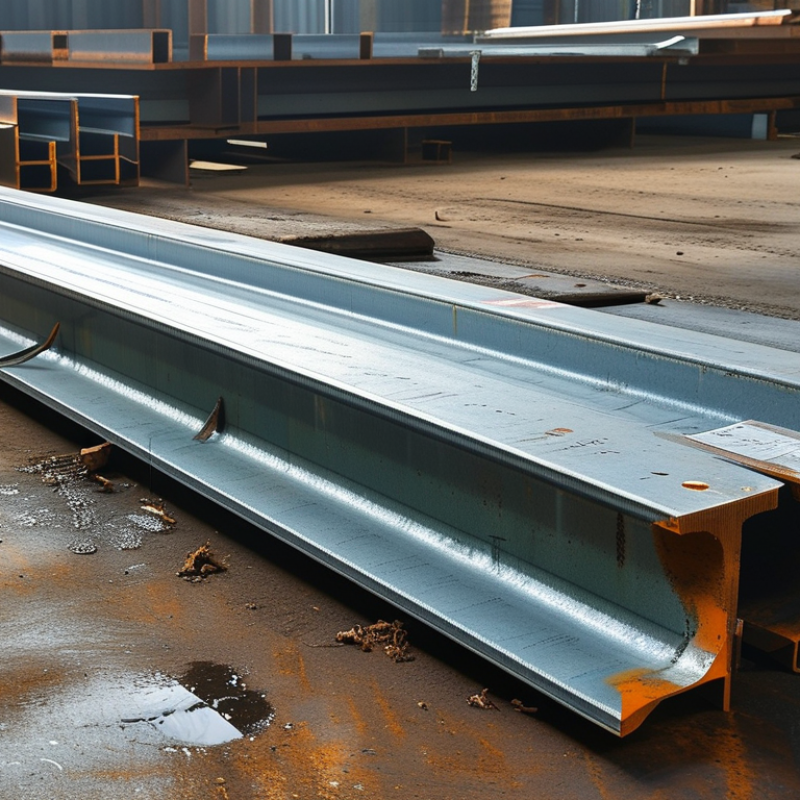
Choosing a galvanized steel I beam starts with the project environment, not the section size. Indoor dry spaces need less corrosion protection than coastal, industrial, or permanently damp sites. Salt spray can attack exposed steel, especially around bolt holes, cut edges, and trapped water.
ISO 1461 specifies an average zinc coating thickness of 85 micrometres for fabricated steel thicker than 6 millimetres. That figure is useful, but it is not a complete design answer. The International Zinc Association reports that zinc corrosion rates change significantly between rural, urban, industrial, and marine atmospheres. Therefore, the expected service life should be estimated from local exposure data, not from a catalogue promise. Coastal projects may need thicker coatings, duplex protection, or more frequent inspections.
Load capacity still matters. Check axial force, bending, buckling length, connection design, and fire conditions using the applicable structural steel standard. Keep the beam elevated from standing water. Provide drainage holes where closed details could trap moisture. Avoid narrow crevices around stiffeners and end plates.
A perfect selection rarely exists. A heavier beam may improve stiffness, yet increase handling, coating cost, and connection complexity. A common mistake is choosing the largest available section and assuming galvanizing solves every durability issue. It does not. Review the site drawings with a corrosion engineer and a structural engineer. Small drainage details often protect more effectively than extra steel.