Contact Kelly McNamara for information on products, services or locations.
Choosing the best coated steel in 2026 is not a simple contest between zinc, aluminum, and polymer finishes. The right choice depends on where the steel will work, how it will be formed, and how long it must last. A roof panel facing salt spray has different needs from an indoor appliance casing. Details matter.
Corrosion authority R. Winston Revie’s work emphasizes the role of the surrounding environment in corrosion. A practical paraphrase—not a verbatim quotation—is: “Choose protection to match the environment the steel will face.” That principle helps frame this comparison. Galvanized steel often suits demanding outdoor applications, while galvalume can offer a useful balance of corrosion resistance and heat reflectivity. Prepainted coated steel adds color and another protective layer, but scratches and cut edges deserve attention.
There is no universal winner. Not even close. Coating weight, substrate quality, forming damage, installation, and maintenance can change the result. A product that performs well on a dry inland site may need a different specification near the coast. And a coating name alone cannot prove service life.
This guide compares common coated steel types by corrosion protection, durability, appearance, cost, and application. It also flags trade-offs that are easy to miss in a datasheet. Some choices still involve judgment; real exposure conditions are rarely perfect laboratory conditions. The aim is a better-informed selection, not a one-size-fits-all answer.
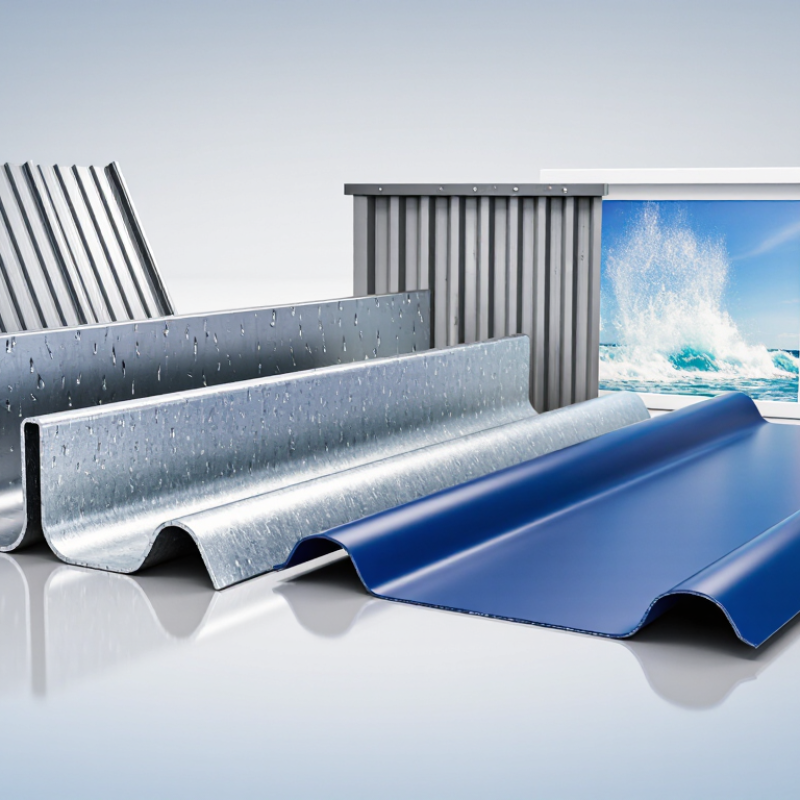
Coated steel is carbon steel with one or more protective layers applied to slow corrosion and improve performance. The coating may be metallic, such as zinc or aluminium-zinc alloy, or organic, such as paint. Think of a cut edge exposed to rain: the steel core faces moisture and oxygen, while intact coating separates them from the surface. Small details matter. Scratches, cut edges, trapped water, and damaged seams can all become weak points.
Zinc protects in two ways. It forms a physical barrier, and it can corrode in preference to exposed steel near a damaged area. This sacrificial action helps protect small scratches, though it does not make the sheet invulnerable. ISO 1461:2022 sets minimum average zinc-coating thicknesses of 70 micrometres for steel 3–6 mm thick and 85 micrometres for steel over 6 mm. These figures are useful benchmarks, not a lifespan guarantee; exposure conditions and maintenance change the outcome.
Painted and polymer-coated steel work mainly as barriers. Their performance depends on layer continuity, adhesion, and resistance to sunlight, abrasion, and chemicals. A primer can improve bonding, while a topcoat limits weathering. Still, “best” is slippery. A coastal roof, an indoor appliance, and a farm building face different moisture and pollutant loads. ISO 9223 classifies atmospheric corrosivity by environmental conditions, reinforcing why coating choice should follow the actual site—not appearance alone.
Coated steel is not one material; performance depends on coating chemistry, thickness, forming, and exposure. Small details matter. Hot-dip galvanized steel has a zinc layer that helps protect cut edges and scratches through sacrificial corrosion protection. It is widely used for building frames, ductwork, and outdoor fixtures. Electrogalvanized steel has a thinner, more uniform zinc coating, often useful where a smooth surface is needed before painting.
Aluminum-zinc alloy coatings combine aluminum’s surface protection with zinc’s protection at exposed edges. They are common on roofing and wall panels, though performance depends on the environment and product specification. Newer zinc-aluminum-magnesium coatings can offer improved resistance at cut edges in some applications. Results vary; salt spray tests alone do not predict every field condition.
Aluminum-coated steel suits applications involving heat, while tinplate is mainly used for containers and packaging. Organic-coated steel, including prepainted sheet, adds color and another protective layer.
Check coating mass, substrate thickness, forming requirements, and the expected service environment before choosing. A panel may look excellent at delivery, yet poorly protected bends can become weak points later. The “best” type is application-specific, and specifications deserve a careful read.
What Is the Best Type of Coated Steel in 2026?
Key Factors for Comparing Coated Steel Performance
There is no universal winner. The right coated steel depends on exposure, forming needs, and maintenance plans. Compare coating type and thickness, not just the product label. In coastal air, salt can accelerate corrosion; inside a dry warehouse, that risk may be far lower. Zinc-coated steel provides sacrificial protection, while zinc-aluminum coatings can perform well in certain outdoor exposures. Organic topcoats add color and another barrier, but scratches and cut edges need attention. A neat laboratory result may not reflect a real site.
The AMPP IMPACT study estimated global corrosion costs at US$2.5 trillion annually, or about 3.4% of global GDP, using 2013 data. That figure makes service-life decisions worth careful review, but it does not identify one best coating. Assess the site’s humidity, salt exposure, pollutants, and temperature. ISO 9223 offers a framework for classifying atmospheric corrosivity. Also check forming requirements: tight bends can strain coatings, and poor edge protection may become a weak point.
Tips: Ask for coating-mass and test-method details, then compare them with the intended environment. Inspect cut edges and formed corners on samples. Consider maintenance access and replacement costs, too. Small detail. One practical limit: exposure tests cannot perfectly predict every site, so review assumptions with a qualified materials engineer.
| Coated Steel Type | Coating / Protection Principle | Corrosion Performance | Forming and Fabrication | Heat and Weather Considerations | Common Uses | Best Fit When… |
|---|---|---|---|---|---|---|
| Hot-dip galvanized steel | A zinc coating protects the steel by acting as a barrier and providing sacrificial protection if the coating is locally damaged. | Reliable general-purpose corrosion protection. Cut edges and scratches can receive some sacrificial protection, though exposed steel can still corrode over time. | Widely used in formed and fabricated products. Coating behavior during forming, welding, and painting depends on coating thickness, steel grade, and process conditions. | Suitable for many outdoor and indoor environments; service life depends strongly on coating mass, moisture, pollutants, and maintenance. | Building components, fencing, structural products, ducts, and general outdoor equipment. | A versatile, widely available zinc-coated sheet is needed at a practical cost. |
| 55% aluminum-zinc alloy-coated steel | Typically about 55% aluminum, 43.4% zinc, and 1.6% silicon by coating weight. Aluminum contributes barrier protection while zinc provides sacrificial protection. | Often offers strong atmospheric corrosion resistance, particularly on broad exposed surfaces. Cut-edge behavior and performance vary with coating, thickness, and exposure. | Commonly used for profiled roofing and cladding. Bending limits and suitability for severe forming should be confirmed with the product specification. | Frequently selected for exterior building applications; suitability near the coast or in aggressive industrial conditions requires exposure-specific evaluation. | Roofing, wall cladding, and other building-envelope products. | Long-lasting exterior sheet performance is a priority and the application is compatible with the product’s forming limits. |
| Zinc-aluminum-magnesium alloy-coated steel | A zinc-based alloy coating containing aluminum and magnesium. Exact composition varies by product; corrosion protection combines barrier and sacrificial effects. | Some formulations show improved corrosion resistance at cut edges and damaged areas compared with conventional zinc coatings, but results depend on coating design and test conditions. | Can be used in formed products, but forming, welding, and coating-repair guidance should be checked for the specific grade and process. | Performance should be matched to the exposure environment; no single composition or result applies to all products in this category. | Building components, solar-support structures, agricultural equipment, and infrastructure products. | Edge protection or demanding outdoor service is important and product-specific test data is available. |
| Aluminum-silicon-coated steel | Type 1 aluminized steel commonly uses an aluminum-silicon coating, often approximately 90% aluminum and 10% silicon by weight. The coating provides a heat- and oxidation-resistant barrier. | Offers good resistance to oxidation and corrosion in suitable environments, but it does not provide zinc-like sacrificial protection at damaged areas. | Used in applications where the coating and steel grade are selected for the required forming and joining operations. | Often chosen for elevated-temperature service; allowable temperature and durability depend on the specific product and operating conditions. | Heat shields, exhaust-system components, and selected industrial or appliance parts. | Heat resistance is a more important requirement than sacrificial protection at scratches or cut edges. |
| Pre-painted coated steel | A factory-applied organic paint system over a metallic-coated steel substrate, commonly galvanized or aluminum-zinc coated. Performance depends on both the metal coating and paint system. | Can provide strong weathering and color retention when the coating system is appropriate for the exposure. Scratches, cut edges, and damaged paint need attention. | Designed for roll forming and building applications, but the paint system has specified limits for bending, handling, and repair. | Outdoor durability varies by paint chemistry, film thickness, color, exposure, and maintenance; verify the coating specification for the intended environment. | Roofing, wall panels, garage doors, appliances, and architectural components. | Appearance, color choice, and a factory-finished surface are key requirements. |
Comparison note: There is no single best coated steel for every application. Actual performance depends on coating composition and thickness, base-steel grade, fabrication, exposure conditions, installation details, and maintenance. Compare product-specific standards, test data, and warranties before specifying a material.
Coated steel performs best when its finish matches the conditions it will face. For damp indoor spaces, zinc-coated steel can provide practical corrosion protection at a reasonable cost. Near coastal air or frequent condensation, aluminum-zinc coatings may offer longer-lasting resistance, though edges and scratches still need attention. No coating is invulnerable.
Think about the whole service environment. A roof exposed to strong sun may need a durable painted finish that resists fading, while formed panels require a coating that can tolerate bending without cracking. In agricultural buildings, cleaning chemicals and persistent moisture can change the choice. Small details matter. A cut edge beside a drain may corrode sooner than the broad, coated surface. Check technical data for coating weight, forming limits, and maintenance guidance rather than relying on a generic label. On paper, two finishes can look similar; in practice, installation damage or trapped moisture may shorten service life. It is easy to overvalue the thickest coating, and I would reconsider that choice if the steel is poorly detailed or rarely inspected.
What the chart shows: Selected EN 10346 coating designations and their minimum total coating mass on both sides, in g/m². Z is zinc, AZ is aluminium-zinc, and ZM is zinc-aluminium-magnesium.
Choosing a coating: Coating mass alone does not determine service life. Match the coating to the exposure environment, forming and joining requirements, cut-edge protection needs, and applicable product specifications.
Selecting coated steel starts with the conditions it must survive. A roofing panel near the coast faces salt spray, strong sun, and trapped moisture. A dry indoor partition may need less corrosion resistance but a durable painted finish. Identify the exposure, expected service life, and maintenance access before comparing products. Small details matter.
Galvanized steel uses a zinc coating that protects exposed areas, including some scratches. Zinc-aluminum coatings can offer a different balance of corrosion resistance and surface protection. Prepainted steel adds color and a finish, but the paint system must suit sunlight, abrasion, and cleaning methods. Compare coating weight, paint type, substrate thickness, and manufacturer test data—not just the product name. More coating is not automatically better.
Fabrication changes the decision. Tight bends, drilled holes, and cut edges can expose the underlying steel, so ask how the selected material performs after forming. Check compatibility with fasteners and nearby metals, especially in damp conditions. For chemical plants or animal buildings, seek project-specific guidance; ordinary outdoor ratings may not cover those exposures. I would avoid choosing from a sample alone. A small panel can look excellent while hiding a weak edge detail, and that is easy to overlook. Before ordering, review drawings, storage plans, and installation practices with the supplier.